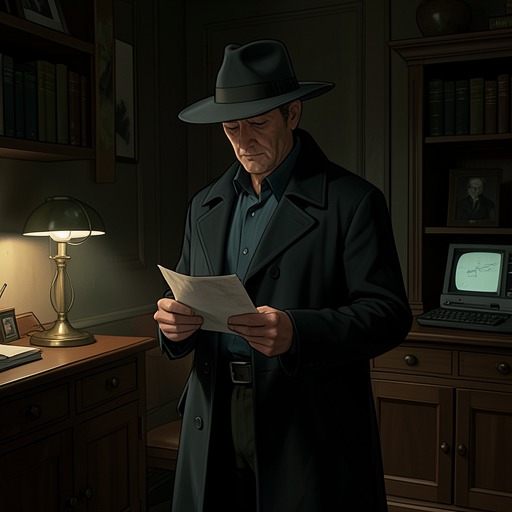
Crosbie Wells’s identity papers
The LuminariesCrosbie Wells’s identity papers are more than personal records: his birth certificate and miner’s right become tools in Francis Carver’s attempt to pass under another man’s name, and their disappearance leaves Wells struggling to prove who he is. Later, the papers’ connection to the hidden bonanza and to disputed signatures makes them part of a broader contest over which documents—and which identities—the law will recognize.
What the Papers Contained
Wells identifies the papers he wants returned as his miner’s right, birth certificate, and a letter from his father. In a later conversation, he groups them with his other certificates and papers, treating them as a body of records that establish his identity and standing. The miner’s right has a practical function in the goldfields; the birth certificate supplies a name and its full form; the letter from his father belongs to a personal history that is not otherwise set out in these scenes. The narrative does not reproduce the documents in full, so their precise wording and other contents remain unknown.
The birth certificate matters especially because it gives the name Crosbie Francis Wells. In June 1865, a scarred man who later proves to be Carver brought a birth certificate to Benjamin Löwenthal’s office and used it to identify himself as Mr. Crosbie Francis Wells while placing an advertisement for a lost shipping crate. The ad offered twenty pounds for the crate’s return, or fifty if it came back unopened, and directed respondents to an address on Gibson Quay. When Löwenthal set the notice, he removed the middle name to prevent the final word from being stranded at the top of a newspaper column. The man returned the next morning and insisted that Francis be included. The small correction establishes how important the complete documentary name was to Carver’s performance, although the reason for his insistence is not explained there.
Carver’s Use of the Records
The papers’ role in Carver’s impersonation emerges through accounts that do not settle every detail of their provenance. Crosbie later insists that his certificates, miner’s right, and other papers had been in a safe at Cumberland Street, and says that Carver, an ex-convict who had served time at Cockatoo Island Penitentiary, took them. He describes himself as left with nothing but the shirt on his back and accuses Carver of using his name. This is Wells’s account of the theft; the papers themselves are not shown being recovered from Carver.
Other evidence connects the documents to Carver’s assumed identity. Moody reconstructs that Carver possessed Wells’s birth certificate when he placed the newspaper advertisement, while the sale document for the Godspeed named its purchaser as Francis Wells. The signature was written so ambiguously that it could be read as either Francis Wells or C. Francis Wells. Moody reasons that Carver had taken the certificate to pose as Crosbie Wells, but also recognizes that the available evidence leaves questions: whether the certificate was genuine, and why Carver chose that name in his dealings with Alistair Lauderback. The document establishes what name Carver could claim; by itself, it cannot explain the motives or circumstances behind the claim.
Concealment Alongside the Bonanza
The papers become physically linked to Wells’s gold. When Wells asks Lydia Wells where she has hidden the bonanza, he also asks for his miner’s right, birth certificate, and letter from his father. Lydia tells him that the papers are with the gold but refuses to disclose the hiding place. The records are thus caught up in the same concealment as the fortune: valuable not simply as objects, but as things whose location and control might enable someone to act in Wells’s name.
Wells eventually draws his own inference from their disappearance. He believes Lydia took both the bonanza and the papers, and reasons that the documents must have been passed to someone who needed another man’s identity—a person fleeing a stained past and seeking a better name. He tells Anna Wetherell that he expects to meet Francis Carver that night. His conclusion links the stolen records to Carver, but the scene presents it as Wells’s reasoning, not as a complete account of how each paper travelled from the safe to Carver.
Documents as Evidence
The novel makes identity depend on comparisons between documents as well as on possession of them. While examining papers in Alistair Lauderback’s trunk, Moody finds the Godspeed bill of sale and notices the purchaser’s deliberately ambiguous signature. Elsewhere, Crosbie Wells’s correspondence supplies a signature that Moody compares with the deed of gift to Anna Wetherell and Wells’s marriage certificate. He argues in court that those signatures match one another but not the signature on the ship’s bill of sale, and uses the discrepancy to show that the bill of sale is forged.
That comparison gives the papers a force beyond Carver’s attempted impersonation. A name on a certificate or contract can be copied, manipulated, or made ambiguous; a signature becomes persuasive only when set beside other records whose origins and associations can be assessed. Yet the surviving evidence also has limits. The narrative raises the possibility that a middle name could have been added to a certificate, and Moody’s reasoning about Carver’s purpose remains partly conjectural. The papers do not produce a single, effortless truth. Their custody, alterations, and comparison instead make identity a matter to be argued from documents—and make those documents themselves vulnerable to the same uncertainty.